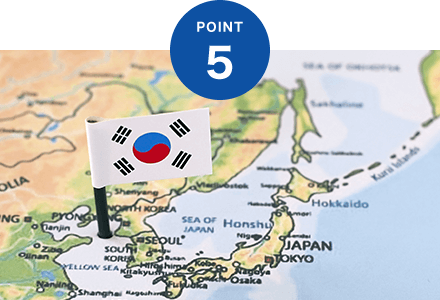
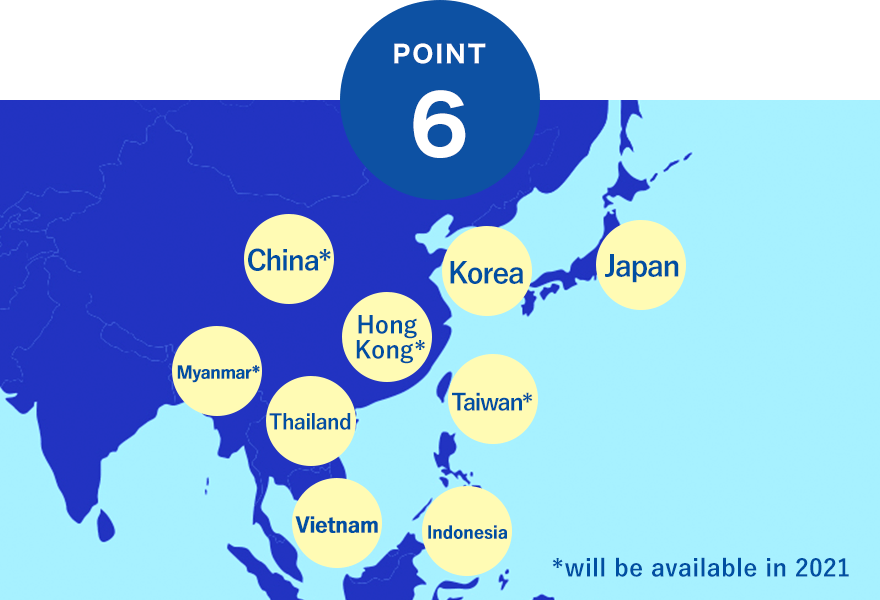
JPT is a test for certification that is targeted to people whose mother tongue is not Japanese to pursue further studies in Japan’s educational institution which has been acknowledge by Japan’s Immigration Services Agency. JPT was held and developed with a goal of measuring communication ability objectively, including business and daily life situation. JPT was first introduced in 1985, and has been held for more than 340 times in South Korea, Japan, Thailand, Vietnam, Indonesia, and has more than 100.000 applicants annually.
JLPT is held by an affiliated organization of Japan’s Ministry of Foreign Affairs also known as Japan Foundation. It is held twice annually and consists of level N1-N5 a 5 grade evaluation, and candidates need to wait for 2 months until the result announcement. On the other hand, JPT (Japanese Proficiency Test) is held 12 times a year, and scores will be shown with the units of 5 score, results will be announced after 2 weeks. The test can be applied whenever, and how many times the candidates want to measure their ability. And since JPT has a maximum score of 990, it can be used to apply for certain occupation that needs a sophisticated Japanese skills. JPT evaluation’s does not determine the pass and failure of test, instead it will accurately measure the ability comparison of the candidates.
| JPT | JLPT | |
|---|---|---|
| Evaluation method | Non grade evaluation with 990 maximum score | N1-N5 a 5 grade evaluation |
| Test frequency | 12 times a year | Twice a year |
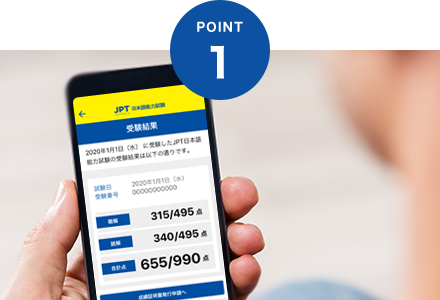
| Result announcement | In 2 weeks time | Around 2 months |
| Level comparison | Score above 660 points | N1 |
| Score above 525 points | N2 | |
| Score above 430 points | N3 | |
| Score above 375 points | N4 | |
| Score above 315 points | N5 |
JPT’s question structure is the same as TOEIC®, which will be 100 questions for listening, and 100 questions for reading, in total of 200 questions. Since questions will be changed for every time the test is held, JPT uses a high dimensional Item Response Theory to adjust the difficulty level so there will be no difference in the evaluation standard just like TOEIC® and TOEFL®.
| Part | Number of questions | Content measurement | Score | |
|---|---|---|---|---|
| Listening (45 minutes) |
Describing pictures | 20 questions | To measure one’s listening ability and immediate decision-making ability by looking at pictures while listening to the recording, and choose a correct answer from 4 available picture options. Also a part to get used to the recording. | 495 points |
| Question and Answer period | 30 questions | To measure the ability to quickly respond to a conversation by listening to short conversation recordings, and choose a correct answer. | ||
| Dialogue sentence | 30 questions | To measure the ability to catch the situation, contents’ outline and detail information correctly by listening to the conversation. | ||
| Explanation sentence | 20 questions | A part where candidates will listen to a long narration, and answer 3-4 questions about the content of the narration to measure the ability to understand narration contents. | ||
| Reading (50 minutes) |
Finding the correct answer | 20 questions | To measure one’s basic Japanese knowledge by evaluating Japanese kanji literacy including reading, writing, general grammar and vocabularies. | 495 points |
| Error correction | 20 questions | Indirectly measure one’s ability to compose a basic sentence by choosing an answer from 4 underlined vocabulary or sentence which is wrongly used. | ||
| Fill in the blanks | 30 questions | To measure one’s ability to compose complete sentences by completing the blanks from certain passages correctly. This part’s goal is the same as the Error correction’s which is to measure one’s basic sentences composition ability. | ||
| Reading | 30 questions | To measure one’s ability to understand the flow of conversations and detail expressions by reading various long passages. | ||
| Total | 200 questions | 990 points |
||
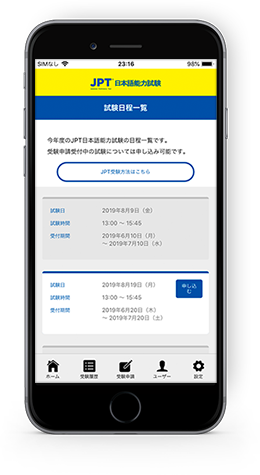
| Test frequency | Test date | Test site | Registration period |
|---|---|---|---|
| The 346th | January 31st, 2021 (Sunday) | Tokyo, Osaka | November 25th, 2020 (Wednesday) – December 25th, 2020 (Friday) |
| The 347th | February 21st, 2021 (Sunday) | Tokyo, Aichi, Chiba, Kyoto | December 21st, 2020 (Monday) – January 21st, 2021 (Thursday) |
| The 348th | March 21st, 2021 (Sunday) | Tokyo, Osaka, Kanagawa | January 22nd, 2021 (Friday) – February 22nd, 2021 (Monday) |
| The 349th | April 18th, 2021 (Sunday) | Tokyo, Osaka, Shizuoka | February 18th, 2021 (Thursday) – March 18th, 2021 (Thursday) |
| The 350th | May 16th, 2021 (Sunday) | Tokyo, Fukuoka, Hyogo | March 16th, 2021 (Tuesday) – April 16th, 2021 (Friday) |
| The 351th | June 20th, 2021 (Sunday) | Tokyo, Osaka, Aichi | April 20th, 2021 (Tuesday) – May 20th, 2021 (Thursday) |
| The 352th | July 18th, 2021 (Sunday) | Tokyo, Kanagawa, Kyoto | May 18th, 2021 (Tuesday) – June 18th, 2021 (Friday) |
| The 353th | August 15th, 2021 (Sunday) | Tokyo, Osaka, Aichi | June 15th, 2021 (Tuesday) – July 15th, 2021 (Thursday) |
| The 354th | September 12th, 2021 (Sunday) | Tokyo, Chiba, Hyogo | July 12th, 2021 (Monday) – August 12th, 2021 (Thursday) |
| The 355th | October 17th, 2021 (Sunday) | Tokyo, Osaka, Fukuoka | August 17th, 2021 (Tuesday) – September 17th, 2021 (Friday) |
| The 356th | November 14th, 2021 (Sunday) | Tokyo, Osaka, Aichi, Shizuoka | September 14th, 2021 (Tuesday) – October 14th, 2021 (Thursday) |
| The 357th | December 26th, 2021 (Sunday) | Tokyo, Osaka | October 26th, 2021 (Tuesday) – November 26th, 2021 (Friday) |